Being a protected consumer is worth more to a small Pakistani household than any appliance upgrade. The rates are a fraction of the normal tariff. Yet many families lose the status without realising it, and then pay much higher bills for months. This guide explains the rule clearly, shows what crossing the line really costs, and gives practical ways to stay protected or win the status back.
What a protected consumer is
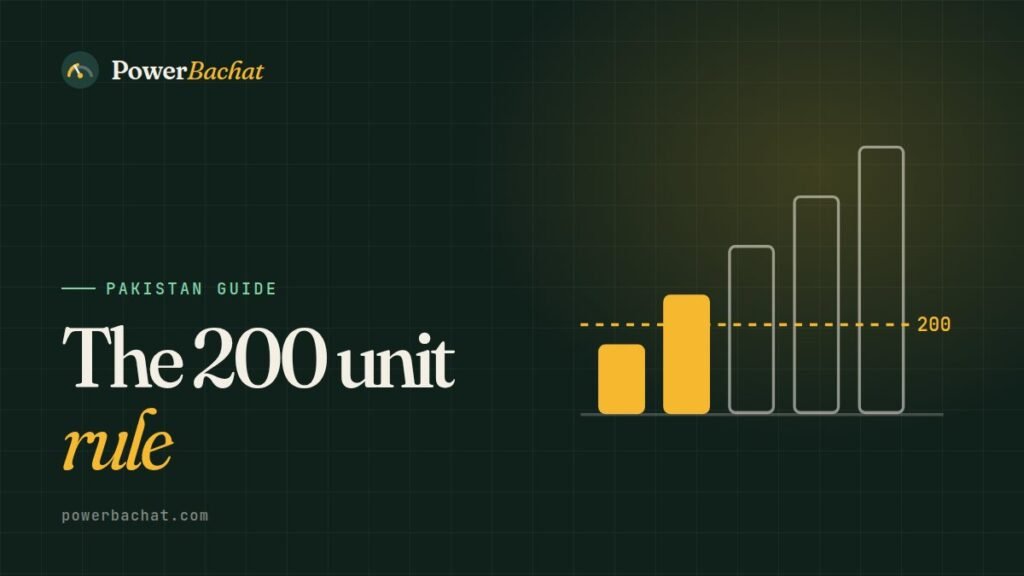
A protected household is a residential connection that has used 200 units or less in each of the previous six consecutive months. If your home meets that condition, you are billed on the protected tariff, which has much lower rates for the first 200 units. Homes with very low use, typically up to 50 units, may fall into an even cheaper lifeline category.
Here are the current protected rates next to the normal ones:
| Units in the month | Rate per unit |
|---|---|
| 1 to 100 units | Rs 7.74 |
| 101 to 200 units | Rs 10.06 |
| Units in the month | Rate per unit |
|---|---|
| 1 to 100 units | Rs 22.44 |
| 101 to 200 units | Rs 28.91 |
| 201 to 300 units | Rs 33.10 |
| 301 to 400 units | Rs 37.99 |
| 401 to 500 units | Rs 40.22 |
| 501 to 600 units | Rs 41.62 |
| 601 to 700 units | Rs 42.76 |
| Above 700 units | Rs 47.69 |
The six-month rule
The status is decided by your history, not just this month. Your company looks at the last six months of consumption on your account. If every one of them is at 200 units or less, you are protected. If even one is above 200, you are not, and you stay non-protected until you have built up six clean months again.
That is what makes the rule so powerful and so painful. One heavy month does two things. It is billed at the normal, higher rates. And it removes your protected status for the following months until a fresh six-month run of 200 units or less is complete.
What crossing 200 units really costs
Look at what a protected home pays at 200 units, compared with a non-protected home at 201 units:
| Units | Energy charge | Taxes | Estimated bill | Per unit |
|---|---|---|---|---|
| 150 | Rs 1,277 | Rs 249 | Rs 1,526 | Rs 10.17 |
| 200 | Rs 1,780 | Rs 347 | Rs 2,127 | Rs 10.64 |
| Units | Energy charge | Taxes | Estimated bill | Per unit |
|---|---|---|---|---|
| 201 | Rs 5,168 | Rs 1,008 | Rs 6,176 | Rs 30.73 |
| 250 | Rs 6,790 | Rs 1,324 | Rs 8,114 | Rs 32.46 |
The step from 200 to 201 units is the most expensive single unit most families will ever use. And the higher rates continue for months afterwards, even if usage falls back below 200. The chart on our electricity bill calculator page shows this cliff visually.
How to tell whether you are protected
Your bill shows a table of your units for the last twelve months. Check the most recent six. If all of them are 200 or below, you should be on the protected tariff. Some bills also print the tariff category or mention protected status directly. If your history qualifies but your bill shows normal rates, ask your company’s local office to check, and take copies of the bills.
Our guide on how to read your electricity bill shows where the history table appears.
When families usually lose the status
- The first hot month. In most of Pakistan, May or June is when fans run all day and the AC comes out. One week of heat can push the month over 200.
- Guests and weddings. Extra people, extra cooking and long nights add units quickly.
- Winter heating in the north, when gas pressure drops and an electric heater comes out.
- Estimated readings. A catch-up after an estimated bill can push one month above 200 even if real use was spread out.
- A new appliance like a deep freezer or a second fridge that runs all the time.
Practical ways to stay protected
- Read your meter weekly. Note the reading every Sunday. You will see trouble coming with enough time to act.
- Know your daily budget. 200 units a month is about 6.6 units a day. If you are using more than that by mid-month, slow down.
- Plan the last ten days. If you are close, keep the AC to one room and fewer hours for the rest of the cycle.
- Fix wasteful loads. A faulty water pump float, an old fridge seal or a geyser left on all day can quietly cost dozens of units.
- Switch to efficient basics. LED bulbs and DC inverter fans cut steady daily use, which is what protected status depends on.
To see what each appliance uses, read our guide on what one unit of electricity is.
How to get protected status back
There is no form to fill in. You regain the status by using 200 units or less in each of six consecutive months. For most families, the realistic window is the cooler half of the year, from about October to March. Plan for it: if you lost the status in summer, make October the first clean month and keep going until April.
A worked example
The Ahmed family in Faisalabad used between 160 and 190 units a month from November to April, so they were protected all spring. In late May a heatwave arrived. By May 20 their meter showed 150 units used in the cycle, and the pace pointed to about 230 for the month. They had a choice: carry on as normal, or hold back for ten days.
They ran the numbers on our FESCO bill calculator. At 230 units on the normal tariff, the bill was several times higher than at 195 units on the protected tariff, and the normal rates would continue into the following months. They moved the family into one room with the AC for the hottest hours, used the cooler elsewhere and shifted laundry to the morning. They finished at 196 units. It was not a comfortable ten days, but it saved them a large sum that month and kept the cheaper rates for the next one.
Shared meters and the protected rule
When two families share one meter, their units are added together, and the combined total almost always passes 200. If that is your situation, a separate connection for each household can turn one non-protected bill into two protected ones. Ask at your company’s local office about the requirements and fees. The saving over a year is often far more than the cost of the new connection.
Is it worth trying to stay protected?
For small households that sit around 150 to 250 units, almost always yes. The difference in rates is large, and the habits that keep you under 200 are not difficult. For larger homes that use 400 units or more in summer, staying protected all year is usually not realistic. For them, the better strategy is to keep summer use in the lower slabs and to look at rooftop solar, which our solar calculator can size.
Frequently asked questions
How many units make a protected consumer?
200 units or less in each of the last six consecutive months.
If I use 201 units once, how long do I lose protected status?
Until you have six consecutive months at 200 units or less again. In practice that means at least six months.
Is the rule the same for all companies?
Yes. LESCO, IESCO, MEPCO, K-Electric and every other company apply the same national rule for household connections.
Does solar help me stay protected?
It can. Solar reduces the units you draw from the grid, which can keep a home under 200 units in months when it would otherwise go over.